This paper considers several alternative explanations for the fact that households with higher levels of lifetime income (‘the rich’) have higher lifetime saving rates (Dynan, Skinner, and Zeldes 1996; Lillard and Karoly 1997). The paper argues that the saving behavior of the richest households cannot be explained by models in which the only purpose of wealth accumulation is to finance future consumption, either their own or that of heirs. The paper concludes that the simplest model that explains the relevant facts is one in which either consumers regard the accumulation of wealth as an end in itself, or unspent wealth yields a flow of services (such as power or social status) which have the same practical effect on behavior as if wealth were intrinsically desirable.
Keywords: saving, consumption, Life Cycle model, rich, bequests, inheritance
JEL Codes: D11, D12, D31, D91, E21 H23, H24
This paper was published in the volume Does Atlas Shrug? The Economic Consequences of Taxing the Rich, Harvard University Press, 2000, Edited by Joel B. Slemrod:
@inproceedings{WhyDoTheRich,
  author = {Christopher D. Carroll},
  booktitle = {Does Atlas Shrug? The Economic Consequences of Taxing the Rich},
  editor = {Joel B. Slemrod},
  publisher = {Harvard University Press},
  title = {Why Do the Rich Save So Much?},
  chapter = 14,
  year = 2000,
  url = {https://llorracc.github.com/WhyDoTheRich/blob/main/Why.pdf},
}
I am indebted to Sidney Carroll, Elizabeth B. Carroll, and Elizabeth I. Carroll for many of the insights in this paper. Any errors are my own.
F. Scott Fitzgerald, to Ernest Hemingway:
“The very rich are different from you and me.”Ernest Hemingway, to F. Scott Fitzgerald:
“Yes. They have more money.”1
The saving behavior of the wealthy has received remarkably little academic attention in the past twenty years or so. This is probably largely attributable to a relative lack of good data: The Survey of Consumer Finances is virtually the only publicly available source of detailed data on wealthy households, and even the SCF has only a few hundred really wealthy households in each triennial wave. Despite recent neglect, the topic is an important one for scholars of saving behavior, for at least two reasons. First, wealthy households should provide a powerful means of testing whether the standard model of consumer behavior, the Life Cycle/Permanent Income Hypothesis, is adequate as a universal model of saving and consumption. This is an application of the general scientific principle that models should be tested under extreme conditions; if they do not hold up, a new model (or an extended version of the old one) is called for. The second reason for studying the wealthy is that they account for a large share of aggregate wealth. In fact, some understanding of the saving behavior of the wealthy is probably indispensable to any credible attempt to account for the magnitude of aggregate wealth.
Although the primary source of evidence in this paper will be the four Surveys of Consumer Finances conducted in 1983, 1989, 1992, and 1995, the inevitable limitations of those data will be apparent. The paper therefore also relies to a considerable extent on unorthodox kinds of evidence, ranging from information in the annual Forbes 400 tabulation of the richest American households, to quotations from and about the very rich, to the results of a “focus group” meeting with a set of wealthy individuals who were directly asked their reasons for saving.
The paper begins by considering whether the standard model of household consumption and saving decisions, the Life Cycle model, provides an adequate description of the behavior of wealthy households. I argue that the Life Cycle model, or at least the traditional incarnation in which the decision-maker saves mainly to finance his own future consumption, cannot simultaneously explain both the behavior of the median household and the behavior in the upper tail of the wealth distribution. The next section of the paper considers whether a “Dynastic” model, in which the wealthy save mainly for the benefit of their heirs, performs better. While the Dynastic model can explain some observations, and probably does roughly apply to some households, I argue that it still does not explain some important facts about the saving behavior of the wealthy. Furthermore, the Dynastic model conflicts with the self-reported motives for saving that many wealthy people voice. Finally, I consider a model in which the wealthy save because, either directly or indirectly, they obtain greater pleasure from possessing an extra dollar of wealth than they would get from an extra dollar of consumption. Following Max Weber 1905 as interpreted by Zou 1994 and Bakshi and Chen 1996, I call this the “Capitalist Spirit” model. I argue that a direct wealth accumulation motive is indispensable in explaining at least some of the observed behavior of the very wealthy.
A provocative recent paper by Hubbard, Skinner, and Zeldes 1994 (henceforth, HSZ) argues that an expanded version of the Life Cycle model in which uncertainty is modelled realistically can generate patterns of wealth accumulation that are roughly consistent with average data from household surveys, and amounts of aggregate wealth that are similar to observed aggregate household wealth in the U.S. If such a model really did produce roughly correct predictions for household wealth holdings, there would be little need to study the very wealthy in detail, since they would merely be scaled-up versions of everyone else.
Behind the scenes of the HSZ model, however, all is not well. While it is true that the model can predict approximately correct average values for wealth or the wealth-to-income ratio, it achieves this average by making large but offsetting errors in predicting the underlying distribution of wealth. Specifically, the HSZ model predicts, at most ages, that the household with median wealth actually holds substantially more wealth than the median household in SCF data holds and, at the same time, the model greatly underpredicts the amount of wealth held by the households at the top of the wealth distribution.
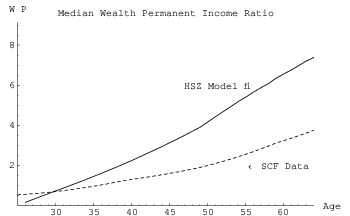
Figure 1 presents data on the age profile of the ratio of total wealth to permanent income for the median household in a stochastic Life Cycle model very similar to that of Hubbard, Skinner, and Zeldes.2 The figure also presents data on the age profile of the actual median household’s wealth/permanent income ratio from the 1992 and 1995 Surveys of Consumer Finances (dashing lines) during the working lifetime.3 The figures make clear that the HSZ model substantially overpredicts the wealth of the median household in the SCF data.4
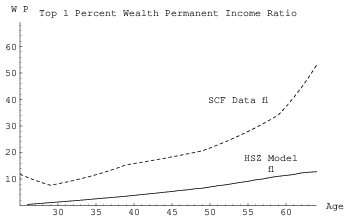
How, then, can the HSZ model produce overall averages that resemble the means of the SCF data? The answer lies in the wealth holdings of the top few percent of the distribution. The solid line in figure 2 shows, for each age group, the average ratio of wealth to permanent income for households at the 99th percentile (by age) in the HSZ model. The dashing line shows the corresponding calculation using the actual data from the 1992 and 1995 SCFs. Clearly, the richest SCF households own enormously more wealth, in relation to their permanent income, than the richest consumers in the HSZ model.
Taken together, Figures 1 and 2 show that the stochastic Life Cycle model under HSZ parameter values matches the aggregate and average data only because it makes two offsetting errors: overestimating the wealth of the typical household and underestimating the wealth of the richest households.
These simulations indicate that even the extended Life Cycle model misses some crucial features of household behavior. However, the model’s overprediction of the wealth of the median household is easily rectified; Carroll 1992, 1997 argues that the model captures the main features of the behavior of the median household very well if consumers are assumed to be slightly more impatient than HSZ assume, and if the income process is modified to include the benefits of aggregate productivity growth (HSZ assume that households expect, and experience, zero aggregate productivity growth over their lifetimes).
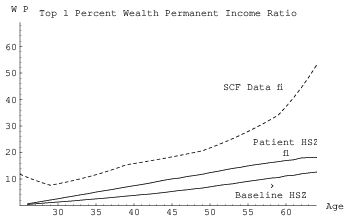
If assuming that consumers are somewhat more impatient can make the stochastic Life Cycle model match the behavior of the median household, a natural question is whether assuming that consumers are somewhat more patient can make the model match the richest households. If so, then it might be possible to argue that the only modification needed to make the stochastic Life Cycle model match the facts is to assume that consumers with higher lifetime incomes are also more patient. Figure 3 examines this possibility by showing the pattern of wealth over the working life of consumers who are the same as the consumers in the baseline HSZ model except that they have a time preference rate of zero rather than the baseline HSZ time preference rate of 3 percent annually. While the age/wealth profile is certainly higher than in the standard HSZ model, it remains far below the profile for the consumers in the top 1 percent of the SCF data. Plausible modifications of other parameter values also fail to raise the model profile to the level found in the data. In other words, the richest households are saving more than can be justified even in a version of the Life Cycle model that allows for very patient consumers with a strong precautionary saving motive.
The evidence presented thus far has concerned the saving behavior and wealth profiles of consumers during the working period of life. The Life Cycle model has another set of testable implications for behavior in the latter stages of life, after retirement. In particular, according to the standard Life Cycle model, even patient consumers want to spend all of their wealth before they die. Of course, an uncertain date of death makes this difficult to achieve on one’s own. However, there is a financial instrument which accomplishes exactly the goal implied by the model: annuities. One test of the rough accuracy of the basic Life Cycle model is therefore whether the wealth of retired households is largely annuitized.
Carrying out such a test requires some methodology for calculating annuity wealth. I assume that the annuity is fixed in real terms (primarily because the largest form of annuity income, Social Security, is inflation-adjusted). I assume a real interest rate, and use the mortality tables from HSZ to construct the expected present discounted value of a one-dollar per year annuity as:
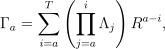 | (1) |
where  is the probability of surviving from year
  to year
  and
and
 is the gross interest rate (I assume
  but results would be
similar for other plausible interest rates). The wealth value of the observed
annuity income YANN at age a is then
but results would be
similar for other plausible interest rates). The wealth value of the observed
annuity income YANN at age a is then  YANN
YANN .
.
Using this method, and including home equity among annuitized wealth, the mean household over age 65 has approximately 55 percent of their wealth in annuitized form. However, among the richest 1 percent of households, the mean annuitization rate is only 10 percent.
This evidence on annuitization is suggestive, but hardly conclusive. Annuity markets are likely far from perfect; as in other insurance markets, adverse selection may distort the market sufficiently to make inference hazardous. Furthermore, annuities are the perfect financial vehicle to counter only one kind of risk, mortality risk. If other kinds of risk are important, it is no longer obvious that even selfish Life Cycle consumers should annuitize most or all of their wealth. For example, if there is a small probability of a very expensive medical problem, it may be important to have access to a large chunk of nonannuitized wealth in order to pay the bills (assuming that no health insurance will fully cover every possible medical catastrophe or every potentially desirable experimental treatment).
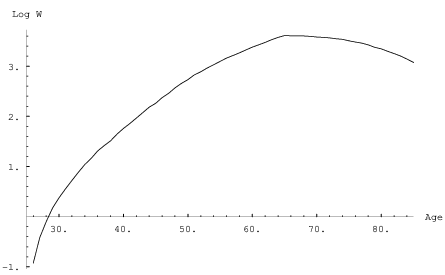
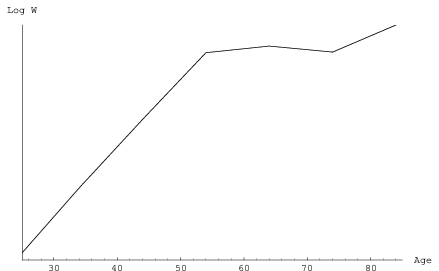
An extreme assumption would be that annuity markets are so imperfect that, for practical purposes, we can assume that annuities cannot be purchased. This assumption would obviously vitiate the argument that the failure of the wealthy to annuitize their wealth proves that they are not Life Cyclers. However, in the absence of annuities the Life Cycle model has other implications. In particular, it implies that selfish Life Cycle consumers, even patient ones, will eventually begin running down their wealth as they age. Figure 4 shows that by age 80 or so the HSZ model implies that consumers should be dissaving at a fairly substantial pace (the simulations here follow HSZ’s assumptions about mortality rates, which they derived from actuarial data, with the modification that they assume that death occurs for certain at age 100 if it hasn’t happened yet). However, Figure 5 shows the actual average age profile of wealth across the four SCF surveys. Although wealth accumulation slows, or perhaps halts, around age 65, there is no noticeable decumulation of assets for consumers in the top percentile of the wealth distribution.5
Of course, nothing in economics requires us to believe that the only purpose of saving is to finance one’s own future consumption; that is merely a hypothesis of the basic Life Cycle model. One natural idea is that the wealthy do not run down their assets because they want to leave bequests to their children. This thought leads to the next model.
“I would as soon leave my son a curse as the almighty dollar.” Andrew Carnegie.
In the 1995 issue of the annual Forbes 400 count of the richest Americans, there are at least 11 households containing descendants of Pierre du Pont (died 1817). This might seem to be compelling evidence that at least some of the very rich have a powerful bequest motive. On the other hand, apparently no members of the 400 trace their wealth to Robert Morris, reputed to be the wealthiest man in America at the time of the Revolutionary War. And Andrew Carnegie gave away over 90 percent of his fortune before he died. Furthermore, the fact that large bequests to children do occur does not prove that provision of such bequests is the primary motivation for accumulation.
This section of the paper considers a particular model of bequests proposed by
Barro 1974. The dynast alive at time  is assumed to solve the intertemporal
maximization problem:
is assumed to solve the intertemporal
maximization problem:
where  corresponds to the lifetime consumption spending of the generation
living at time
corresponds to the lifetime consumption spending of the generation
living at time  ,
,  is the dynasty’s wealth,
  is the (noncapital) income
earned by that generation,
is the (noncapital) income
earned by that generation,  is the intergenerational interest rate, and
  is the
discount factor. The implications of this equation for macroeconomics
spawned the large literature on Ricardian equivalence in the 1970s and
1980s. More recently, Altonji, Hayashi and Kotlikoff 1992 have tested
the Dynastic model with household-level data from the Panel Study of
Income Dynamics and rejected its strong implication that only dynastic
resources should matter for any individual family’s consumption. The typical
PSID family, however, is not particularly wealthy, so those results do not
necessarily imply that the Dynastic model is a poor one for the wealthiest
families.
is the
discount factor. The implications of this equation for macroeconomics
spawned the large literature on Ricardian equivalence in the 1970s and
1980s. More recently, Altonji, Hayashi and Kotlikoff 1992 have tested
the Dynastic model with household-level data from the Panel Study of
Income Dynamics and rejected its strong implication that only dynastic
resources should matter for any individual family’s consumption. The typical
PSID family, however, is not particularly wealthy, so those results do not
necessarily imply that the Dynastic model is a poor one for the wealthiest
families.
Although intuition suggests that the dynastic model might be interchangable with other models in which leaving a bequest yields utility, in fact the model has distinctive implications, such as Ricardian equivalence, that need not follow from other models of bequests. As a result, the economic literature has drawn a distinction between Dynastic models like the one specified in equation 3 and “Joy of Giving” models in which the bequest yields utility directly. For example, the Dynastic model implies that the size of the bequest should be a function of the ratio of the parent’s lifetime income and the child’s lifetime income; that parents should give larger bequests to poorer children; and that childless wealthy people should leave no bequests. All of these implications of the Dynastic model have been tested in population-representative datasets and none has received consistent empirical support. This section provides evidence that the Dynastic model is also a poor description of the behavior of the richest households.
To begin with some very informal evidence, Kennickell, Starr-McCluer, and Sunden 1995 report some results from a “focus group” session on saving motivations that was convened as part of the preliminary work in designing the questions for the 1995 SCF.6 The eight members of the group were all wealthy individuals,7 mostly in their 50s. Participants were asked “Thinking about your reasons for saving, what sorts of reasons are most important to you?” In the entire course of a three hour conversation of saving behavior, however, providing a bequest was not mentioned once as a reason for saving.8
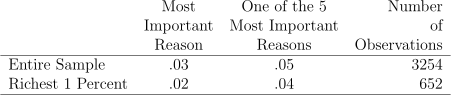
A group of eight individuals is obviously too small a sample to convincingly demonstrate the general absence of a bequest motive among the wealthy. Somewhat more persuasive evidence is provided in the results of survey questions on the 1992 SCF. Respondents were asked to list their five most important reasons for saving. As shown in Table 1, only three percent of the general population, and two percent of the wealthy households, indicated that providing an inheritance was the most important reason to save. 9 Furthermore, only 5 percent of the total population and 4 percent of the wealthy households indicated that providing an inheritance was among their top 5 reasons for saving. (The differences between the wealthy households and the general population are not statistically significant here.)
Another obvious test of the model is to see whether the childless elderly tend to dissave more than those with children. This hypothesis has been tested using population-representative data; Hurd 1986 found that in the population as a whole, there is no tendency for elderly with children to decumulate faster than those without. Unfortunately, even when the data from the four SCFs are combined, the number of childless, elderly, wealthy households is too small to permit reliable estimation of age profiles of wealth (only about ten percent of elderly couples are childless).
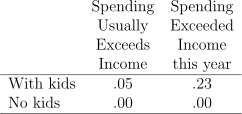
Another option is to consider what childless elderly people say about their saving and spending behavior. Respondents to the 1992 and 1995 SCFs were asked whether their spending was greater than, equal to, or less than their income over the past year, and how spending usually compared with income. The results are presented in Table 2.10 The childless elderly were less likely to say that they dissave than those with children, by this crude measure, either as a general rule or in the current year in particular. Of course, it is possible that some of the “spending” of the elderly with children consists of inter vivos transfers to those children. The real problem for the Life Cycle model is the testimony of the childless, wealthy elderly, essentially none of whom say that their spending exceeds their income. This is all the more impressive given the comparatively small fraction of their income that is annuitized.
Given the paucity of publicly available data on the very wealthy, it is not surprising that the economic literature contains almost no empirical studies that shed any light on the behavior of the childless wealthy elderly (although there have been several studies that have examined the behavior of non-wealthy childless elderly households, and have found that they do not dissave; see, e.g., Menchik and David 1983 and the references therein). I was able to find only one study that contains even tangential information on the subject, a paper by Auten and Joulfaian 1996 which uses a proprietary dataset compiled by the Internal Revenue Service on 1982 decedents who paid estate taxes. From figures in their Table 1, p. 62 it is possible to calculate that the mean wealth of the childless decedents was virtually identical to that of those with children - hardly what would be expected if those with children had a powerful dynastic saving motive which the childless (presumably) do not share.11 Furthermore, those with children actually contributed slightly more to charity during their lifetimes than the childless. Again, a dynastic motive would suggest the opposite. Finally, Auten and Joulfaian found no significant effect of children’s income on the size of charitable bequests. This finding is consistent with evidence by Wilhelm 1996 who found little support for the altruism model’s implication that the size of bequests in families with more than one child should be related to the relative lifetime income of the children. Instead, Wilhelm found roughly equal bequests in about 80 percent of bequests.
This section presents a model in which wealth enters consumers’ utility functions directly, and argues that such a model is both consistent with the available data on the saving behavior of the wealthy and plausible on grounds other than its consistency with these facts. Zou 1994 and Bakshi and Chen 1996 have recently noted that Max Weber 1905 long ago argued that the pursuit of wealth for its own sake was the ‘spirit of capitalism,’ and so I will call this the ‘Capitalist Spirit’ model.
Consider a consumer with lifetime wealth  . Suppose the utility function for
lifetime consumption is a standard CRRA utility function,
. Suppose the utility function for
lifetime consumption is a standard CRRA utility function,  , and
suppose the consumer also obtains utility from wealth in a modified Stone-Geary
form,
, and
suppose the consumer also obtains utility from wealth in a modified Stone-Geary
form,
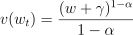
Formally, the consumer’s maximization problem is:
The problem as described thus far can be interpreted in either of two ways. The first interpretation is that the model describes a consumer deciding how to allocate lifetime resources between consumption and wealth, with wealth yielding utility directly. The second interpretation is of a consumer deciding how to allocate lifetime resources between lifetime consumption and end-of-lifetime wealth. (The reasons end-of-period wealth might yield utility include the “Joy of Giving” bequest motive mentioned above, and several others. See below for further discussion).The first order condition for an interior solution to this problem is:
Call the which satisfies this equation
  . It is clear that for
sufficiently small
. It is clear that for
sufficiently small  the equation will be satisfied only by choosing a
  larger than
  , that is, by ending with negative wealth. If we impose the
condition that consumers may not die in debt, the solution to the problem is:
If
, that is, by ending with negative wealth. If we impose the
condition that consumers may not die in debt, the solution to the problem is:
If  , end-of-period wealth will be a luxury good. Furthermore, if
  is
positive, there will be a range of initial wealth such that the marginal value
of an extra dollar of consumption always exceeds the marginal value of
an additional dollar of wealth. In this range, the consumer will choose
to spend all available resources and end the period (and life) with zero
wealth.
is
positive, there will be a range of initial wealth such that the marginal value
of an extra dollar of consumption always exceeds the marginal value of
an additional dollar of wealth. In this range, the consumer will choose
to spend all available resources and end the period (and life) with zero
wealth.
The problem can be solved analytically if we choose  and
and  . If we
set
. If we
set  the solution is
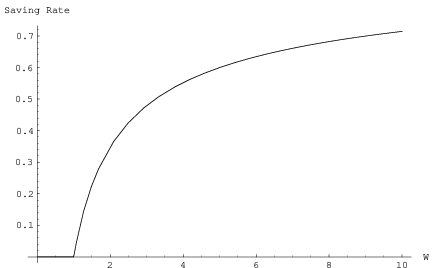
 . Figure 6 shows
the saving rate of this consumer as initial wealth goes from 0 to 10. For initial
wealth between 0 and 1 the consumer saves nothing, but above initial wealth of 1
the saving rate rises monotonically. Furthermore, as
. Figure 6 shows
the saving rate of this consumer as initial wealth goes from 0 to 10. For initial
wealth between 0 and 1 the consumer saves nothing, but above initial wealth of 1
the saving rate rises monotonically. Furthermore, as  the saving rate
approaches 100 percent.
the saving rate
approaches 100 percent.
The essential insights from this model carry over when the model is extended to many periods and when labor and capital income are incorporated: consumers with permanent income below a certain threshhold will behave like standard Life Cyle consumers and will try to spend all their assets before death, while consumers with permanent incomes above the threshhold will save at ever increasing rates as lifetime income rises.
The idea that bequests (charitable or otherwise) are insignificant for most of the population, but become increasingly important in the upper reaches of the lifetime income distribution, has been informally expressed by several previous authors. Indeed, Modigliani 1986 himself has argued that, to the extent that bequests must be included in the Life Cycle framework, they should be incorporated in precisely this “luxury good” manner. There is also a growing body of empirical evidence in support of the proposition. Dynan, Skinner, and Zeldes 1996 examine data from several micro datasets and find consistent and strong evidence that households with higher lifetime income leave larger bequests; Lillard and Karoly 1997 find similar results.
In theoretical terms, the value added in this paper relative to the previous literature is simply the proposal of a specific and simple functional form for the consumer’s utility function which captures the informal idea that rich people save more in a way that is at least roughly consistent with the empirical evidence marshalled above. But such consistency may not be a high enough standard.
“Utility maximization is a metaphysical concept of impregnable circularity.” Joan Robinson 1962, Economic Philosophy, Ch. 3.
The essence of Joan Robinson’s complaint about utility theory was that it is possible to construct a utility function to justify any conceivable behavior: Just assume that the behavior in question yields more utility than its alternatives. Any postulated utility function, or proposed modification to a standard utility function, should therefore be defensible on grounds other than its ability to match the facts it was created to match. This section argues, using a variety of informal evidence, that most qualitative descriptions of the behavior of the wealthy, both by the wealthy themselves and by outside observers, can be interpreted at a fundamental level as implying that wealthy people derive utility either directly from the ownership of wealth or indirectly, either from the activities that lead to wealth accumulation or from a flow of services that is closely tied to the ownership of that wealth.
The first important argument about the plausibility of the Capitalist Spirit model concerns the assumption that the marginal utility of consumption decreases sharply with the level of consumption. What matters critically here is really the assumption that there is an alternative way to employ wealth whose marginal utility decreases more slowly than that of consumption (and hence will be a luxury good relative to consumption). It is important to recall that the kind of consumption treated in the model is for strictly nondurable goods and services. Carroll and Inhaber 1992 note that “luxury” goods that are generally associated with the wealthy such as art, estates, jewelry – even sports teams – are almost all assets. Indeed, beyond a certain level of wealth it becomes difficult to imagine how one could spend even the earnings on one’s wealth on nondurable goods and services for personal enjoyment. For example, recent press accounts have estimated Bill Gates’s net worth at $40 billion. Assuming a ten percent annual rate of return, Gates would have to spend $4 billion a year, or over $10 million a day, on nondurable goods and services simply to avoid further accumulation.
The proposition that the marginal utility of consumption approaches zero as the level of consumption rises is also lent credence by statements of wealthy people themselves. Andrew Carnegie, Cornelius Vanderbilt, and other fabulously wealthy people refer to their “surplus” wealth, and of determining when one has “enough” wealth. H.L. Hunt, then the richest man in the world, once said that “for practical purposes, someone who has $200,000 a year is as well off as I am.” Similar statements (appropriately adjusted for inflation) have been attributed to William Henry Vanderbilt and John Jacob Astor, two 19th century plutocrats.
One of the appealing features of the idea that rich people eventually reach near-satiation in their consumption of nondurables is that this means one need not assume a towering and obsessive greed lies behind their continuing accumulation. If ‘greed’ is defined as a desire to possess wealth for its own sake, even a modest amount of greed will suffice, so long as greed does not diminish with wealth as fast as the marginal utility diminishes with consumption. Or, to put the idea more concretely, if ownership of extra houses, yachts, artwork, or, for that matter, corporations has even a modest intrinsic appeal, eventually that appeal is likely to exceed waning lure of an extra dollar of nondurable consumption. Of course, this is merely another way of saying that ownership of these kinds of wealth yields utility directly, as the basic Capitalist Spirit model assumes.
Of course, towering and obsessive greed cannot always be ruled out.
“The point is that you can’t be too greedy.” Donald Trump 1988, in Trump: The Art of the Deal, ch. 2.
“Greed is good.” Ivan Boesky, in an address to business school students, University of California at Berkeley, 1987.
“The one with the most toys when he dies, wins.” Anonymous
And, among the 19th century plutocrats, according to historian Frederic Cople Jaher 1980,
Money-making and keeping, not adorned or rationalized by nobler explanations, actually constituted a powerful force in the lives of the very rich. As boys, [Mining magnate William Boyce] Thompson and [John D.] Rockefeller vowed to accumulate a fortune. Thompson.…and [Andrew] Carnegie promised themselves to retire after reaching a certain level of wealth, but kept pushing onward. Rogers, a Rockefeller disciple and associate, said that the Standard Oil partners made the profit motive a ‘religion,’ a faith ‘taught’ them by ‘Mr. Rockefeller.’
To the extent that these quotations express the general truth about the motivations of the wealthy, the Capitalist Spirit model can be said to apply directly. However, the view that all wealthy people are motivated solely by a love of wealth for its own sake is surely extreme. A variety of other plausible, and apparently very different, motivations are commonly proposed, ranging from job satisfaction to status-seeking to philanthropic ambitions to power-lust. The remainder of this section argues that, from a modelling standpoint, these other common ideas–different though they may be from a psychological perspective–are essentially indistinguishable from each other and from the basic Capitalist Spirit model in terms of their implications for individual behavior. The argument, therefore, is that if any of these several proposed motivations is correct, the Capitalist Spirit model constitutes an appropriate mathematical model of the behavior of the wealthy.
Perhaps the most obvious example of a psychologically very different model which would be behaviorally indistinguishable from the wealth-in-the-utility-function model is the idea that the wealthy enjoy doing their jobs well, and that they view the accumulation of wealth as the principal measure of job performance. This idea appears frequently both in the statements of the wealthy themselves and in commentary by others on the behavior of the wealthy. Two particularly direct statements are:
“The rich man’s ‘duty,’ such as it is, is not to society but to his art, and his art is making money.” Michael Lewis, The New York Times Sunday Magazine, July 1995
“Money’s just a way of keeping score. It’s the game that matters.” H. L. Hunt, cited in Jaher 1980, p. 215
A closely related idea is suggested by the work of Robert Frank 1985, who has argued that an intrinsic component of human nature is a tendency to judge oneself by comparison with others. If for some wealthy people wealth is the metric of comparison, the utility function should contain not the absolute level of their wealth but some function of the relationship of their wealth to that of others. Bakshi and Chen 1996, Cole, Mailath, and Postlewaite 1992, and Zou 1994 have also argued that wealth matters because it is an index of social status.12 For practical purposes of analysis of household-level data, however, either of these ideas is virtually indistinguishable from the proposition that wealth enters the utility function directly, and both ideas should produce essentially identical results in a model of saving (although they might have different implications for optimal tax policy; see the discussion below and the paper by Frank in this volume).13
It is also possible that wealthy people continue accumulating because greater wealth yields some other benefit that is more difficult to measure, such as power. In particular, the view that wealth brings power is commonplace among both the wealthy themselves and observers of the wealthy. (The idea that power is desirable appears to be taken for granted.)
“The ultimate gift of colossal wealth, at least for the founders of the richest families, was power.” Jaher 1980, p. 215
“Money is the measuring rod of power.” Howard Hughes
“’Twasn’t the money we were after, ’twas the power. We were all playing for power. It was a great game.” James Stillman, Gilded Age financier, cited in Jaher 1980
“If you give away the surplus [money], you give away the control.” Cornelius Vanderbilt, cited in Jaher 1980
“‘Tis a sort of duty to be rich, that it may be in one’s power to do good, riches being another word for power.” Lady Mary Wortley Montagu (1689-1762), English society figure, letter writer. Letter, c. 24 Sept. 1714, to her husband, cited in Jaher 1980.
This last quotation raises a final idea that crops up frequently in the statements of the wealthy themselves: that the purpose of accumulating wealth is ultimately to enable the wealthy person to pursue philanthropic activities, or to establish institutions to carry out such activities. While such an evidently self-serving interpretation should be subject to considerable skepticism, there are many prominent examples of philanthropy that bear out the proposition. The Ford Foundation, the Rockefeller Foundation, Carnegie-Mellon University, Duke University, Johns Hopkins University, the Getty museum, and a host of other prominent institutions owe either their existence or a substantial part of their endowments to the munificence of wealthy individuals (often, although not always, manifested through bequests). Morally, socially, and psychologically this motivation for wealth accumulation is very different from pure greed. However, if more wealth allows one to establish a larger foundation or endow more institutions, the implications for saving behavior are again virtually indistinguishable from the idea that wealth enters the utility function directly.
Assuming that the Capitalist Spirit model provides a roughly correct description
of the behavior of wealthy households, a natural question to ask is what the
model implies about the relationship between accumulation behavior and
taxes. 14
Returning to the parameterized version of the model in which  and
and
 , if bequests (or wealth) are taxed at rate
  then the equation for
optimal consumption becomes:
then the equation for
optimal consumption becomes:
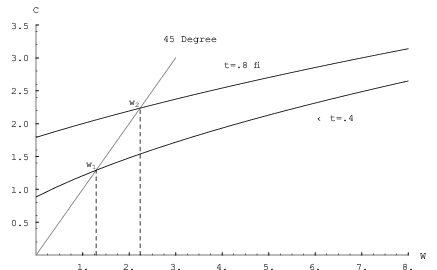
Figure 7 shows the effect on consumption if bequest taxes are increased from
40 percent to 80 percent. Consider first the curve labelled  , which shows
the optimal amount of consumption for consumers facing a 40 percent bequest tax
if bequests are not constrained to be positive. The actual consumption function,
of course, is the minimum of the 45 degree line and this curve. The point of
intersection of this curve and the 45 degree line, labelled
, which shows
the optimal amount of consumption for consumers facing a 40 percent bequest tax
if bequests are not constrained to be positive. The actual consumption function,
of course, is the minimum of the 45 degree line and this curve. The point of
intersection of this curve and the 45 degree line, labelled  , reveals
the level of lifetime wealth at which consumers begin to leave positive
bequests.
, reveals
the level of lifetime wealth at which consumers begin to leave positive
bequests.
When the bequest tax is raised to 80 percent, the amount of consumption
shifts up, as indicated in the curve labelled  . The point at which
consumers begin leaving bequests,
. The point at which
consumers begin leaving bequests,  , is substantially higher than when the tax
rate was 40 percent.
, is substantially higher than when the tax
rate was 40 percent.
Hence, it is useful to think of the effects of raising the bequest tax by
considering three categories of consumers. The first are those with lifetime wealth
less than  . They leave bequests under neither tax regime, so their behavior is
unaffected by the tax increase. The second region is those consumers with lifetime
wealth between
. They leave bequests under neither tax regime, so their behavior is
unaffected by the tax increase. The second region is those consumers with lifetime
wealth between  and
and  . These are the consumers who would leave bequests
if the bequest tax were only 40 percent, but prefer to consume all of their lifetime
wealth when the bequest tax rises. Finally, consumers with lifetime wealth greater
than
. These are the consumers who would leave bequests
if the bequest tax were only 40 percent, but prefer to consume all of their lifetime
wealth when the bequest tax rises. Finally, consumers with lifetime wealth greater
than  will leave bequests even when the bequest tax is 80 percent.
However, at any level of lifetime wealth the size of the bequests they leave is
reduced by an amount equal to the gap between the two consumption
curves. It is simple to show that as lifetime wealth goes to infinity the
fraction of lifetime wealth bequeathed approaches 100 percent even with
the higher bequest taxes. This is the region of the model presumably
corresponds best to the circumstances of fabulously wealthy people like Bill
Gates.
will leave bequests even when the bequest tax is 80 percent.
However, at any level of lifetime wealth the size of the bequests they leave is
reduced by an amount equal to the gap between the two consumption
curves. It is simple to show that as lifetime wealth goes to infinity the
fraction of lifetime wealth bequeathed approaches 100 percent even with
the higher bequest taxes. This is the region of the model presumably
corresponds best to the circumstances of fabulously wealthy people like Bill
Gates.
Because the effect of taxes on consumption depends on the distribution of
consumers across the different levels of lifetime income, the aggregate effect of
bequest taxes in this model is impossible to judge in the absence of evidence (or
assumptions) about the distribution of lifetime income (and information about
the parameters of the model). If most bequests come from people with
 , then an increase in the bequest tax could reduce bequests almost
to nothing. If, on the other hand, most bequeathed wealth comes from
consumers with very large amounts of lifetime income, increasing the
bequest tax might have very little effect on either consumption or (pre-tax)
bequests.
, then an increase in the bequest tax could reduce bequests almost
to nothing. If, on the other hand, most bequeathed wealth comes from
consumers with very large amounts of lifetime income, increasing the
bequest tax might have very little effect on either consumption or (pre-tax)
bequests.
In principle, it should be possible to tease out estimates of the relevant
parameter values from available data on wealth, consumption and income, using
methods like those employed in an impressive recent paper by Gourinchas and
Parker 2002. Those authors assume a “residual value function” that characterizes
the utility experienced during the last part of life that is mathematically very
similar to the “bequest utility” function postulated in the model here. Gourinchas
and Parker assume that the coefficient of relative risk aversion for the residual
value function is the same as for the period utility function, and they do
not incorporate a Stone-Geary term like my  , but their estimation
methodology could easily be adapted to estimate those two additional
parameters. Having estimated those parameters, they could then perform
simulations to gauge the predicted impact of changes in bequest taxes on
consumption.
, but their estimation
methodology could easily be adapted to estimate those two additional
parameters. Having estimated those parameters, they could then perform
simulations to gauge the predicted impact of changes in bequest taxes on
consumption.
A variety of evidence, both qualitative and quantitative, strongly suggests that people at the top end of the wealth and income distributions behave in ways that are substantially different from the behavior of most of the rest of the population. In particular, it is difficult to explain the behavior of these consumers using the standard Life Cycle model of consumption. A leading alternative to (or perhaps just an extension of) the Life Cycle model is the Dynastic model in which the decisionmaker cares about the utility of his descendants. The Dynastic model, however, has problems of its own, starting with the testimony of many wealthy households who say that providing an inheritance is not a principal motivation for saving and ending with the fact that childless wealthy old people do not appear to dissave. I argue that the simplest model capable of fitting all the facts is a model in which wealth either enters the utility function directly as a luxury good, or wealth yields a stream of services that enter the utility function in ways that would be formally virtually indistinguishable from a model in which wealth enters the utility function directly.
In a way, the model reconciles Fitzgerald and Hemingway. Fitzgerald was right that rich do not behave simply as scaled-up versions of everyone else. They choose to save more and to accumulate faster because they can “afford” the luxury of doing so. But Hemingway was right to suggest that the rest of us would probably behave the same way, if only we had more money.
Andrew B. Abel. Asset prices under habit formation and catching up with the joneses. American Economic Review, 80(2):38–42, May 1990.
Fumio Hayashi Altonji, Joseph G. and Laurence J. Kotlikoff. Is the extended family altruistically linked? American Economic Review, 82(5): 1177–98, 1992.
Orazio Attanasio and Guglielmo Weber. Is consumption growth consistent with intertemporal optimization? evidence from the consumer expenditure survey. Journal of Political Economy, 103(6):1121–57, December 1995.
Gerald Auten and David Joulfaian. Charitable contributions and intergenerational transfers. Journal of Public Economics, 59(1):55–68, 1996.
Kyle Bagwell and B. Douglas Bernheim. Is everything neutral? Journal of Political Economy, 96(2):308–338, 1988.
Gurdip Bakshi and Zhiwu Chen. The spirit of capitalism and stock-market prices. American Economic Review, 86(1):133–157, 1996.
Robert J. Barro. Are government bonds net worth? Journal of Political Economy, 82:1095–117, 1974.
John Bartlett. Familiar Quotations. Little, Brown, and Company, Boston, 15 edition, 1980. Edited by Emily Morison Beck.
Martin Browning, Angus Deaton, and Margaret Irish. A Profitable Approach to Labor Supply and Commodity Demands over the Life-Cycle. Econometrica, 53(3):pp. 503–544, 1985. ISSN 00129682. URL http://www.jstor.org/stable/1911653.
Campbell, John Y. and John H. Cochrane. By force of habit: A consumption-based explanation of aggregate stock market behavior. Journal of Political Economy, 107(2):205–251, April 1999.
Christopher D. Carroll. The buffer-stock theory of saving: Some macroeconomic evidence. Brookings Papers on Economic Activity, 1992(2):61–156, 1992. URL https://www.econ2.jhu.edu/people/ccarroll/BufferStockBPEA.pdf. https://www.econ2.jhu.edu/people/ccarroll/BufferStockBPEA.pdf.
Christopher D. Carroll. Buffer stock saving and the life cycle/permanent income hypothesis. Quarterly Journal of Economics, CXII(1):1–56, 1997.
Christopher D. Carroll, Jody R. Overland, and David N. Weil. Comparison utility in a growth model. Journal of Economic Growth, 2(4):339–367, December 1997. URL https://www.econ2.jhu.edu/people/ccarroll/compare.pdf. https://www.econ2.jhu.edu/people/ccarroll/compare.pdf.
Christopher D. Carroll, Jody R. Overland, and David N. Weil. Saving and Growth with Habit Formation. American Economic Review, 90(3):341–355, June 2000. URL https://www.econ2.jhu.edu/people/ccarroll/AERHabits.pdf. https://www.econ2.jhu.edu/people/ccarroll/AERHabits.pdf.
Harold L. Cole, George J. Mailath, and Andrew Postlewaite. Social norms, savings behavior, and growth. Journal of Political Economy, 100 (6):1092–125, 1992.
George M. Constantinides. Habit formation: A resolution of the equity premium puzzle. Journal of Political Economy, 98(3):519–543, June 1990.
Karen E. Dynan, Jonathan S. Skinner, and Stephen P. Zeldes. Do the rich save more? Manuscript, Board of Governors of the Federal Reserve System, 1996.
Robert H. Frank. On Choosing the Right Pond: Human Behavior and the Quest for Status. Oxford University Press, New York, 1985.
Pierre-Olivier Gourinchas and Jonathan Parker. Consumption over the life cycle. Econometrica, 70(1):47–89, 2002.
R. Glenn Hubbard, Jonathan S. Skinner, and Stephen P. Zeldes. The importance of precautionary motives for explaining individual and aggregate saving. In Allan H. Meltzer and Charles I. Plosser, editors, The Carnegie-Rochester Conference Series on Public Policy, volume 40, pages 59–126, 1994.
Michael D. Hurd. Savings and bequests. NBER Working Paper No. 1708, 1986.
Herbert Inhaber and Sidney L Carroll. How rich is too rich?: income and wealth in America. Praeger Pub Text, 1992.
Frederic Cople Jaher. The gilded elite: American multimillionaires, 1865 to the present. In W. D. Rubinstein, editor, Wealth and the Wealthy in the Modern World. Croon Helm, London, 1980.
Arthur Kennickell. Saving and permanent income: Evidence from the 1992 scf. mimeo, Board of Governors of the Federal Reserve System, 1995.
Martha Starr-McCluer Kennickell, Arthur B. and Annika Sunden. Saving and financial planning: Some findings from a focus group. Manuscript, Board of Governors of the Federal Reserve System, 1995.
Lee Lillard and Lynn Karoly. Income and wealth accumulation over the lifecycle. Manuscript, RAND Corporation, 1997.
Paul L. Menchik and Martin David. Income distribution, lifetime savings, and bequests. American Economic Review, 83(4):672–690, 1983.
Franco Modigliani. Life cycle, individual thrift, and the wealth of nations. American Economic Review, 3(76):297–313, June 1986. URL http://www.jstor.org/stable/1813352. Available at http://www.jstor.org/stable/1813352.
Joan Robinson. Economic Philosophy. Aldine, Chicago, 1962.
Donald Trump. Trump: The Art of the Deal. Random House, New York, 1988. With Tony Schwarz.
Max M. Weber. The Protestant Ethic and the Spirit of Capitalism. Charles Scribner and Sons, New York, 1905.
Mark O. Wilhelm. Bequest behavior and the effect of heirs’ earnings: Testing the altruistic model of bequests. American Economic Review, 86 (4):874–982, 1996.
Heng-Fu Zou. The ’spirit of capitalism’ and long-run growth. European Journal of Political Economy, 10(2):279–93, 1994.
![∑∞
max U(Ct ) + βi−tU (Ci ) (2)
Ct i=t+1
s.t. Wt+1 = R[Wt − Ct] + Yt+1,](Why9x.svg)


![cT = Min [c∗,wT ]
T](Why28x.svg)
![∘ ---------------
−-1-+---1-+-4-(1-+-wT-)
cT = Min[ 2 ,wT ]. (5)](Why34x.svg)
![− 1 + ∘1--+-4(w-+-γ-∕(1 −-τ))
cT = min[-----------------------------,wT ]. (6)
2](Why43x.svg)